


Australia Grocery Retail Market Size, Share, Report 2026-2034
Ngày đăng: 26-05-2026 |
Ngày cập nhật: 26-05-2026
Market Overview
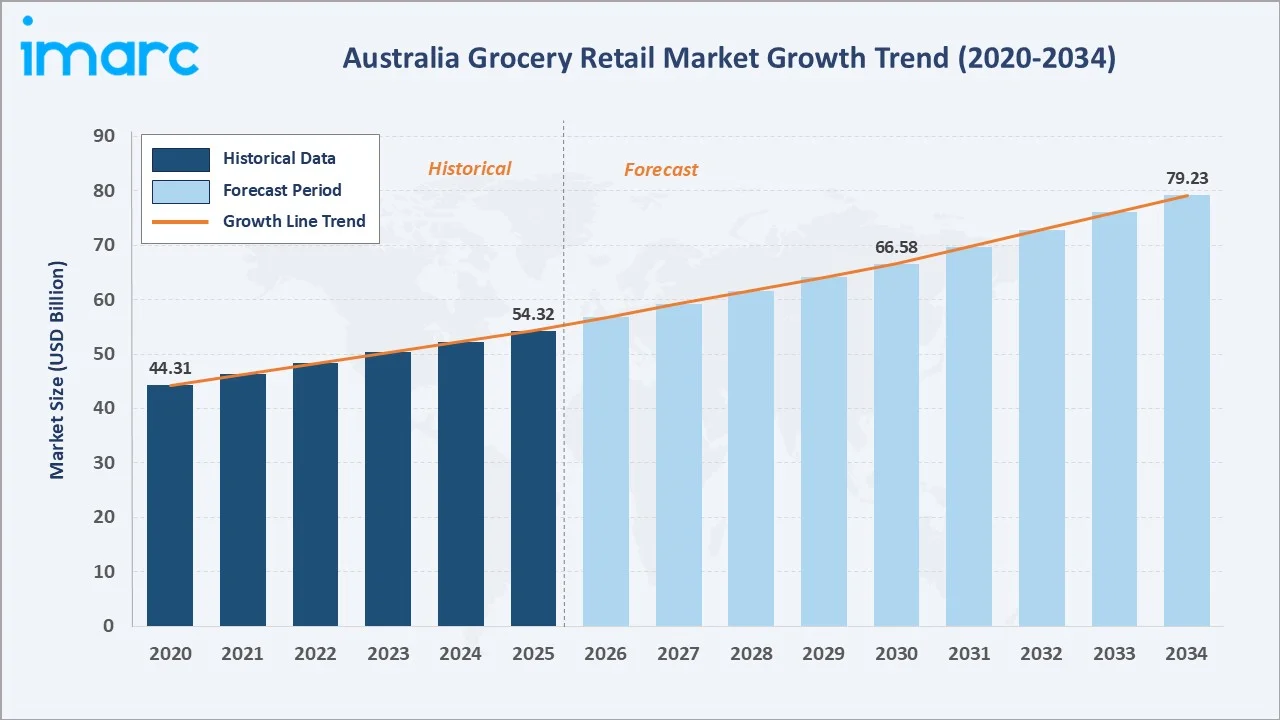
The Australia grocery retail market is witnessing steady growth driven by population expansion, private label proliferation, accelerating online grocery adoption, and consumer premiumisation in health and wellness food categories. The market size reached USD 54.32 Billion in 2025 and is projected to reach USD 79.23 Billion by 2034, exhibiting a compound annual growth rate (CAGR) of 4.16% during 2026‑2034. Food and beverages dominate the product landscape at 71.6%, while hypermarkets and supermarkets lead the distribution channel at 48.9%. Australia's population reached 27.7 million by September 2025, driven by record net overseas migration, which continues to expand the consumer base for grocery products nationwide. This market is strategically important to Australia's retail economy, serving as the primary channel for daily food and household essentials for millions of households.
The Woolworths‑Coles duopoly, commanding approximately 65‑70% of Australia's organised grocery retail market, represents one of the highest concentration levels for any G20 economy's food retail sector. COVID‑19 served as the market's most consequential demand catalyst, with lockdown‑driven at‑home cooking, pantry stockpiling, and avoidance of food service creating incremental grocery revenue during 2020‑2021 that permanently elevated Australia's grocery baseline demand. Online grows fastest at approximately 7.8% CAGR as Amazon Fresh grocery expansion in Sydney and Melbourne collectively builds the infrastructure enabling same‑day delivery at competitive economics.
AUSTRALIA GROCERY RETAIL MARKET SUMMARY
- The Australia grocery retail market encompasses a wide range of products including food and beverages, non‑food items, fresh produce, packaged goods, frozen meals, dairy, meat, seafood, bakery items, and household essentials.
- The ecosystem spans major supermarket chains (Woolworths, Coles, Aldi, IGA), discount retailers, online grocery platforms, convenience stores, specialty food retailers, and the fast‑growing quick commerce segment.
- Major segments identified in the grocery retail industry include product (food and beverages, non‑food items), distribution channel (hypermarkets and supermarkets, convenience stores, online retailers, specialty stores, others), and region (Australia Capital Territory & New South Wales, Victoria & Tasmania, Queensland, Northern Territory & Southern Australia, Western Australia).
- Food and beverages dominate the product segment at 71.6% share in 2025, encompassing all consumable food categories from fresh produce, meat, and dairy through packaged and processed food, frozen meals, snacks, confectionery, and beverages.
- Hypermarkets and supermarkets lead the distribution channel at 48.9% market share (2025), reflecting the established dominance of Australia's full‑service supermarket format.
- Non‑food items sustain approximately 3.9% CAGR, driven by convenience purchasing of household products and personal care at supermarkets, where non‑food gross margins (25‑35%) exceed food margins (20‑28%), incentivising retailers to expand the non‑food category range.
- Australia Capital Territory & New South Wales commands the largest regional share at 33.4% of market revenues (2025), driven by Sydney's concentration of highest‑income households and highest grocery expenditure density.
PORTER'S FIVE FORCES ANALYSIS – AUSTRALIA GROCERY RETAIL MARKET
The competitive dynamics of the Australia grocery retail market can be analysed using Porter's Five Forces framework.
Bargaining Power of Suppliers – Moderate
- Large supermarket chains source from thousands of food producers, farmers, and manufacturers across Australia and internationally. However, major retailers hold significant bargaining power over suppliers due to concentrated purchasing volumes.
- The mandatory Food and Grocery Code of Conduct now includes a ban on excessive pricing of groceries by very large retailers, effective 1 July 2026, providing suppliers with enhanced regulatory protections. The Australian Competition and Consumer Commission (ACCC) has identified significant bargaining power imbalances between supermarkets and suppliers, leading to regulatory strengthening.
- Australian households spend on average 178 per week on groceries, equating to 178 per week on groceries, equating to 771 per month or $9,256 per year, representing significant household expenditure that strengthens buyer price sensitivity and negotiating power.
- Consumers benefit from extensive choice across multiple supermarket chains, discount retailers, online platforms, and quick commerce delivery services. Loyalty programs including Woolworths' Everyday Rewards and Coles' Flybuys are deeply integrated into the shopping experience, powering personalised offers and targeted price promotions.
- 61% of shoppers report doing their shopping across multiple supermarkets to combat high prices, while 71% pay attention to supermarket specials and offers compared to 63% in 2024, demonstrating heightened buyer price consciousness.
- Significant capital requirements for establishing supermarket networks, supply chain infrastructure, distribution centres, and brand recognition create high barriers. Woolworths operates more than 1,130 stores, while Coles operates 867 stores nationwide.
- However, niche entrants focusing on organic, health‑focused, or premium grocery segments are successfully accessing the market with differentiated propositions. Online‑only grocery platforms and quick commerce providers are carving out distinct market positions.
- Aldi has maintained a steady presence since entering Australia in 2001, holding a 9% market share, while Amazon Fresh continues to expand grocery infrastructure in Sydney and Melbourne.
- Traditional grocery retail faces partial substitution from food delivery platforms, meal kit services, and restaurant dining. However, the essential nature of grocery shopping for household food and everyday needs provides strong market resilience.
- Quick commerce and on‑demand delivery services represent complementary rather than fully disruptive forces, offering convenience for top‑up shops while traditional supermarkets retain dominance for weekly bulk shopping.
- The market features intense duopoly competition between Woolworths Group and Coles Group, which together command approximately 65‑70% of Australia's organised grocery retail market, among the highest concentration levels for any G20 economy.
- Woolworths recorded comparable sales growth of 5.3% and 4.4% in recent quarters, outperforming Coles which recorded 3.6% and 2.4% growth, while online sales growth continues to accelerate for both retailers.
- Aldi, Metcash (IGA), Costco, and Amazon compete across value and premium segments, with Amazon holding 7.5% of Australia's online retail market and continuing to expand grocery fulfilment capacity.
MARKET GROWTH DRIVERS
Population Growth and Demographic Expansion Fueling Retail Demand
Several key factors are propelling market growth in the Australia grocery retail market. Australia's population reached 27.7 million by September 2025, driven by record net overseas migration, which continues to expand the consumer base for grocery products across all states and territories. The market expanded from USD 44.31 Billion in 2020 to USD 54.32 Billion in 2025, anchored at USD 66.58 Billion in 2030, and forecast to reach USD 79.23 Billion by 2034, demonstrating consistent growth trajectory supported by favourable demographic trends and sustained household formation. Rising consumer preference for healthier, premium, and convenience food options continues to drive average basket values higher, while increasing urbanisation supports expansion of retail infrastructure across metropolitan and regional areas.
Online Grocery Acceleration and Omnichannel Integration
The accelerating online grocery channel is transforming the grocery retail landscape in Australia. Online grocery sales industry revenue reached an estimated $11.8 billion in 2025‑26, growing at an average annual rate of 5.7% over the five‑year period. Coles' online sales increased by 27.9%, with penetration reaching 13.3%, while Woolworths Group online sales grew 13.2% with penetration reaching 16.2%. Coles' ecommerce now represents 13.1% of supermarket value, while Woolworths online sales exceeded AUD 5 billion in H1 2026, growing 15.3%. Click‑and‑collect remains uniquely popular in Australia, making up approximately 40% of online sales at the top two retailers, supported by Woolworths' Direct‑to‑Boot services which grew 19.4% in the latest quarter. Both retailers are investing heavily in automated fulfilment centres, with Woolworths now operating seven Customer Fulfilment Centres across the country and Coles launching same‑day CFC fulfilled delivery in Melbourne catchments.
Private Label Expansion and Health & Wellness Premiumisation
The Woolworths‑Coles duopoly's private label expansion and consumer premiumisation in health and wellness food categories collectively anchor the market's growth trajectory. Private label performance at Coles grew 5.7%, highlighting continued margin management through owned brands. In 2025, Coles launched over 530 new own‑brand SKUs, helping price‑conscious shoppers stretch their budgets, with shoppers able to save up to approximately 42% by choosing these lines in some categories. Woolworths has frozen the price of 300 of its own label products over three months, demonstrating commitment to value leadership while building brand loyalty. Consumer demand for health‑oriented products, organic offerings, and sustainable sourcing continues to reshape product ranges across all major retailers.
AUSTRALIA GROCERY RETAIL MARKET SEGMENTATION
Segmentation analysis provides a detailed view of the Australia grocery retail market by category:
- Product Insights: Food and Beverages, Non‑Food Items.
- Distribution Channel Insights: Hypermarkets and Supermarkets, Convenience Stores, Online Retailers, Specialty Stores, Others.
- Regional Insights: Australia Capital Territory & New South Wales, Victoria & Tasmania, Queensland, Northern Territory & Southern Australia, Western Australia.
The competitive landscape of the Australia grocery retail market features one of the world's most concentrated grocery retail structures, with Woolworths Group and Coles Group together commanding approximately 65‑70% of Australia's organised grocery retail market. Woolworths Group leads the market with estimated revenue of AUD 46.6 billion, followed by Coles Group with approximately AUD 40.1 billion in revenue. Aldi, Metcash (operating IGA and Foodland), Amazon, and Costco hold the next largest market shares, with Aldi maintaining a 9% market share since entering Australia in 2001. Online grocery activity remains highly concentrated in the two largest chains, which leverage extensive supply and distribution networks and significant pools of capital to control the majority of market share.
Key participants in the grocery retail industry include:
- Woolworths Group Ltd
- Coles Group Ltd
- Aldi Australia
- Metcash Limited (Independent Grocers of Australia/IGA, Foodland)
- Amazon (Amazon Fresh)
- Costco Australia
- Drakes Supermarkets
- FoodWorks
- SPAR Australia
- Romeos Retail Group
REGIONAL ANALYSIS
- Australia Capital Territory & New South Wales commands the largest market share at 33.4% of market revenues (2025), driven by Sydney's concentration of Australia's highest‑income households and highest grocery expenditure density. The region benefits from strong retail infrastructure, extensive supermarket networks, and rapid online grocery adoption. Woolworths has more than 1,130 stores nationwide, with a significant concentration in this region.
- Victoria & Tasmania represents a major grocery retail market anchored by Melbourne's large consumer base. Coles leads in Victoria with 35% consumer preference, compared to Woolworths at 28%. The region benefits from strong agricultural production, supporting fresh food availability, and increasing online grocery penetration across metropolitan Melbourne.
- Queensland sees steady grocery retail demand driven by the state's growing population, with Brisbane and the Gold Coast serving as major consumption centres.
- Western Australia experiences grocery retail growth supported by resource sector employment and population expansion in Perth metropolitan area. Western Australia has seen a 40year‑on‑yearincreaseingrocerybills,adding40year‑on‑yearincreaseingrocerybills,adding2,116.40 in annual shopping costs compared to 2024.
- Northern Territory & Southern Australia contribute to the national grocery market, with Northern Territory households reporting the lowest average weekly grocery bill of 160,whileTasmaniareportsthehighestat160,whileTasmaniareportsthehighestat227 per shop.
RECENT INDUSTRY DEVELOPMENTS
- May 2026: Woolworths has long been Australia's biggest supermarket with a store footprint of more than 1,130, compared with Coles' 867. For the past two quarters, Woolworths has outperformed Coles in terms of sales growth, recording comparable sales growth of 5.3% and 4.4% in the third and second quarter respectively, while Coles recorded 3.6% and 2.4%.
- May 2026: Woolworths announced a profit hit and has frozen the price of 300 of its own label products over the next three months, demonstrating commitment to value leadership amid cost‑of‑living pressures, while both Woolworths and Coles await legal judgments in a Federal Court case brought by the ACCC alleging illusory price discounts.
- March 2026: Coles' online sales increased by 27.9%, with penetration reaching 13.3% while Woolworths Group online sales grew 13.2% with penetration reaching 16.2%. Coles' ecommerce now represents 13.1% of supermarket value, while Woolworths online sales exceeded AUD 5 billion in H1 2026, growing 15.3%.
- January 2026: Australian supermarkets continued rapid transformation driven by technology, changing consumer behaviour, and competitive strategy. Coles and Woolworths introduced Scan & Go and Smart Trolleys in select locations, strengthening partnerships with delivery platforms like Uber Eats and DoorDash, and expanding own‑brand product offerings with Coles launching over 530 new SKUs in 2025.
- December 2025: The Australian Government announced a ban on supermarket price gouging from 1 July 2026 under a new law that would protect shoppers from excessive grocery prices charged by major retailers. The changes make it illegal for very large grocery chains to charge prices deemed excessive relative to their cost of supply plus a reasonable margin.
- April 2025: Labor's new mandatory Food and Grocery Code replaced the previous voluntary framework. For the first time, supermarkets face multimillion dollar penalties for serious breaches. The code now includes a ban on excessive pricing of groceries by very large retailers, effective 1 July 2026.
- 2025 Activity: Coles' customer fulfilment centre partnership with Ocado continued to ramp up capacity, with Melbourne and Sydney CFC catchments expanded and same‑day CFC fulfilled delivery launched. Woolworths opened a new Adelaide CFC, doubling delivery capacity across Greater Adelaide, bringing Woolworths Group's total CFC operations to seven across the country.
ABOUT US
IMARC Group is a global management consulting firm that helps the world's most ambitious changemakers to create a lasting impact. The company provides a comprehensive suite of market entry and expansion services. IMARC offerings include thorough market assessment, feasibility studies, company incorporation assistance, factory setup support, regulatory approvals and licensing navigation, branding, marketing and sales strategies, competitive landscape and benchmarking analyses, pricing and cost research, and procurement research.
CONTACT US
IMARC Group
134 N 4th St., Brooklyn, NY 11249, USA
Email: sales@imarcgroup.com
Tel No: (D) +91 120 433 0800
United States: +1 201 971 6302
Thông tin liên hệ
: rashi.sharma
:
:
:
:
