

Philippines Vinegar Market Size, Share, Trends, Growth & Forecast Report 2026-2034
Market Overview
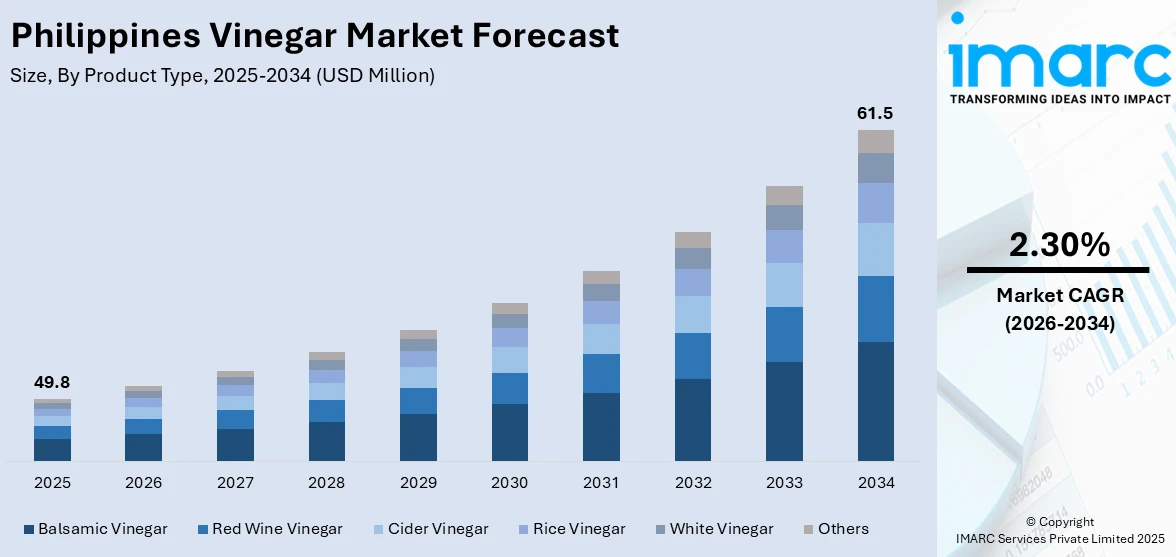
The Philippines vinegar market is growing steadily, driven by its widespread use in cooking, food preservation, and as a household staple. Rising consumer preference for natural and locally sourced products, along with increasing demand from the foodservice sector, supports expansion. The market size reached USD 49.8 Million in 2025 and is projected to reach USD 61.5 Million by 2034, registering a compound annual growth rate (CAGR) of 2.30% during 2026-2034. Traditional varieties such as coconut and cane vinegar continue to dominate consumer preference, while advances in packaging and distribution make products more accessible to wider markets. This strengthens the market’s long-term outlook through 2034.
Request a Sample Report for In-Depth Market Insights: https://www.imarcgroup.com/philippines-vinegar-market/requestsample
Market Summary
- The market reached USD 49.8 Million in 2025 and is forecast to reach USD 61.5 Million by 2034.
- Coconut and cane vinegar are widely popular, rooted in cultural significance and distinct flavour characteristics.
- Consumers see local varieties as affordable, versatile for everyday cooking, and sourced from the local community.
- Health-conscious consumers are shifting toward natural and chemical-free food choices, and vinegar is valued for its digestive, antimicrobial, and preservative benefits.
- Vinegar is used in cooking and as part of home remedies and wellness practices.
- Growth in ready-to-eat meals, processed foods, quick-service restaurants, and food delivery is raising demand for vinegar in marinades, dressings, sauces, and as a preservative.
- The market is segmented by product type (balsamic vinegar, red wine vinegar, cider vinegar, rice vinegar, white vinegar, others), source (natural, synthetic), end use (institutional, retail), distribution channel (supermarkets and hypermarkets, convenience stores, specialty stores, online, others), and region (Luzon, Visayas, Mindanao), with forecasts for 2026-2034.
Market Growth Drivers
Rising Demand for Natural and Traditional Vinegar
Traditional vinegar varieties such as coconut and cane enjoy widespread popularity, rooted in cultural significance and distinct flavour. Consumers increasingly appreciate these local options because they are affordable, versatile for everyday cooking, and sourced from the local community. The authenticity and heritage tied to these varieties keep them the favoured choice over synthetic alternatives. This is sustaining demand for traditional vinegars and motivating local producers to improve production and distribution. As urban and rural households use these products for culinary and preservative purposes, the market shows significant growth potential. The preference reflects a balance between cultural heritage and contemporary consumer preferences.
Growing Preference for Vinegar as a Healthy, Chemical-Free Food Ingredient
Consumers are becoming more health-conscious, leading to a marked shift toward natural and chemical-free food choices. Vinegar, known for its digestive, antimicrobial, and preservative benefits, is receiving greater attention as a safe and healthy substitute for synthetic food additives. This aligns with the global wellness movement, where individuals are more aware of how food choices affect long-term health. Vinegar is used in cooking and as part of home remedies and wellness practices, which adds to its relevance. Manufacturers are investing in organic and additive-free products to meet this demand, and consumers express increased trust in locally produced, chemical-free options.
Increased Use of Vinegar in Ready-To-Eat Meals and Processed Food Products
The rising popularity of ready-to-eat meals and processed foods is driving demand for vinegar as a crucial ingredient. Vinegar is commonly used in marinades, dressings, sauces, and as a preservative, making it integral to food processing. As urban lifestyles become more hectic, consumers look for convenient meal solutions, prompting food manufacturers to include more vinegar in packaged foods. The growth of quick-service restaurants and food delivery services is also boosting demand in commercial food preparation. Vinegar’s ability to enhance flavour, prolong shelf life, and support food safety is expected to keep its use in the processed food sector strong.
Porter’s Five Forces Analysis
Competitive Rivalry: Moderate
- Local producers of coconut and cane vinegar compete with other vinegar types, including balsamic, red wine, cider, rice, and white vinegar.
- Competition centres on price, authenticity, natural and organic positioning, packaging, and distribution reach.
- Improved packaging innovation and expanding online distribution are emerging points of differentiation.
Supplier Power: Moderate
- Local producers draw on community-sourced raw materials for traditional varieties such as coconut and cane vinegar.
- Manufacturers investing in organic and additive-free products depend on consistent input quality.
Buyer Power: Moderate to High
- Retail shoppers can easily switch among brands across supermarkets, convenience stores, specialty stores, and online.
- Institutional and foodservice buyers, such as quick-service restaurants and food manufacturers, purchase in volume and can negotiate on pricing.
- Cost-conscious households favour affordable local varieties.
Threat of Substitutes: Moderate
- Synthetic vinegar and other synthetic additives and flavourings are alternatives, though the page notes consumers favour natural options over synthetic alternatives.
- Other preservatives and acidifiers can replace vinegar in food processing.
Threat of New Entrants: Moderate
- Low-cost, locally sourced production and growing online distribution make entry feasible.
- Established brand loyalty, cultural preference for traditional varieties, and supermarket distribution favour incumbents.
Market Segmentation
Product Type Insights
- Balsamic Vinegar
- Red Wine Vinegar
- Cider Vinegar
- Rice Vinegar
- White Vinegar
- Others
Source Insights
- Natural
- Synthetic
End Use Insights
- Institutional
- Retail
Distribution Channel Insights
- Supermarkets and Hypermarkets
- Convenience Stores
- Specialty Stores
- Online
- Others
Regional Insights
- Luzon
- Visayas
- Mindanao
Regional Analysis
The Philippines vinegar market report breaks the market down across three regions: Luzon, Visayas, and Mindanao. The page does not give regional market shares, a leading region, or region-specific growth drivers, so I have not written region-by-region analysis, because anything beyond the list would be my own assumption rather than source data. Here is what the page supports, which applies nationally:
- Coconut and cane vinegar are popular in both urban and rural households.
- Improved packaging and distribution are making products accessible to wider markets.
- The page gives no data on how vinegar demand differs between Luzon, Visayas, and Mindanao.
Recent Industry News & Developments
September 2026: The National Coconut Research Center–Visayas at Visayas State University (VSU) conducted a facility assessment and coconut water vinegar production training for the Kilusan ng mga Maliliit na Magniniyog ng Pilipinas (KAMMPIL) Agri-Coop in Jaro, Leyte. The initiative focused on improving the cooperative's existing coconut processing operations and introducing better production practices for coconut water vinegar. Conducted with support from VSU departments and the Department of Trade and Industry Region 8, the programme aimed to improve product consistency, processing efficiency, and quality. The initiative also highlights opportunities to convert coconut by-products into commercially valuable food products while creating additional income for farming communities.
August 2026: The Department of Science and Technology–Food and Nutrition Research Institute (DOST-FNRI) introduced FeNRI Suka, an iron-fortified spiced coconut water vinegar developed in partnership with New Pathways Enterprise. Each 15-gram serving provides approximately 35% of an adult's daily iron requirement, while the iron content remains stable throughout its minimum 12-month shelf life. The product is designed to address iron deficiency while creating value from coconut water, a by-product that is often discarded during copra processing. DOST-FNRI estimated that approximately 9.3 billion litres of coconut water are wasted annually during copra production. The proposed production model requires equipment estimated to cost around PHP 47,000, with a feasibility-study price of PHP 62.60 for a 300 ml bottle. The technology offers potential commercial opportunities for food manufacturers and coconut-processing businesses
Key Aspects Required for the Philippines Vinegar Market
- Market Performance: The market reached USD 49.8 Million in 2025 and is projected to reach USD 61.5 Million by 2034.
- Market Outlook: A 2.30% CAGR during 2026-2034 reflects steady, modest growth supported by cultural preference for traditional vinegar, health-conscious demand, and foodservice use.
- Growth Drivers: Rising demand for natural and traditional vinegar, growing preference for vinegar as a healthy, chemical-free ingredient, and increased use in ready-to-eat meals and processed foods.
- Competitive Landscape: The report covers market structure and key player positioning, but the page does not name its key players.
- Value Chain Analysis: The report covers value chain stages, but the page does not describe them.
- Industry Trends: Demand in processed and ready-to-eat foods, organic and additive-free vinegar, improved packaging innovation, and expanding online distribution.
- Key Questions Covered: The report examines market performance, breakups by product type, source, end use, distribution channel, and region, value chain stages, key drivers and challenges, market structure and key players, and the degree of competition.
- Strategic Recommendations: Invest in organic and additive-free coconut and cane vinegar, develop products for processed food and foodservice customers, improve packaging, and expand online and specialty store distribution.
Note: If you need any specific information that is not covered currently within the scope of the report, we will provide the same as a part of customization.
Speak to an analyst: https://www.imarcgroup.com/request?type=report&id=41945&flag=C
Frequently Asked Questions
1. What is the current size of the Philippines vinegar market?
The market reached USD 49.8 Million in 2025.
2. What is the expected growth rate of the Philippines vinegar market during 2026-2034?
The market is projected to grow at a CAGR of 2.30% during 2026-2034, reaching USD 61.5 Million by 2034.
3. What factors are driving the growth of the Philippines vinegar market?
Key drivers include a strong cultural preference for coconut and cane vinegar, a health-conscious consumer shift, foodservice sector demand, and vinegar’s appeal as a natural preservative.
4. Which segments are covered in the report?
The report covers segmentation by product type, source, end use, distribution channel, and region, each with detailed market size and forecast analysis.
5. What trends are shaping the future of the market?
Key trends include rising demand in processed and ready-to-eat foods, organic vinegar preference, improved packaging innovation, and expanding online distribution reach.
